Have a specific winter expense to cover?
Put a clear plan behind the next move: a refrigeration repair, ingredients for a confirmed catering order, or a temporary gap before deposits arrive. Compare any new payment with your slower weeks, then explore available options.
Explore Restaurant Funding Options →
Starting criteria: 3+ months in business and $10,000+ monthly business revenue. Prepare your four most recent completed monthly business bank statements, all pages. Provider approval, costs and terms vary; meeting minimums does not guarantee funding. See the application checklist.
A quiet Tuesday can feel louder than a packed Saturday. The dining room has empty tables. The kitchen is ready. Your team is on the schedule. Rent, insurance and the next supplier payment are still coming.
For a restaurant owner, a winter slowdown is not simply a sales problem. It is a calendar problem: money coming in changes faster than the obligations going out. A busy holiday weekend can hide a weak stretch that follows it. A strong summer does not automatically pay February’s bills.
Before you borrow to get through a slower period, build a plan that answers one question: what changes before the funding runs out?
What would breathing room let you put back to work?
Picture your next service with the walk-in stocked for the dishes that actually sell. The refrigeration repair is scheduled. A confirmed catering order has the ingredients and packaging it needs. You are making decisions from a plan instead of moving one bill behind another.
Those are concrete uses of working capital—not reasons to borrow more than your restaurant can support. Put a dollar amount and a date beside the improvement you need. Then compare the benefit with the full funding cost and the payment your slower weeks would carry.
Have a specific use for capital? Start your restaurant funding application so Hybrid Funder can review your business for potential options with third-party providers. Applying does not guarantee approval or commit you to accepting an offer. Review all proposed terms before deciding.
First, find out whether your restaurant actually has a winter pattern
Not every restaurant slows down in winter. A ski-town dining room may do its best business then. A neighborhood restaurant may have strong holiday catering followed by softer weekday covers. Weather, tourism, local events and your customer mix matter more than a generic seasonal headline.
Start with your own point-of-sale reports and bank deposits. Compare the same weeks across available years, then account for changes in hours, menu prices, seating, delivery platforms and special events. Separate dine-in, takeout, delivery, catering and private events. One channel may be growing while another is shrinking.
Use deposited cash for payment planning. A sale recorded today may settle later; a platform payout may arrive net of fees, refunds or adjustments. Gift-card receipts also create a future obligation to serve a meal. Do not count tomorrow’s hoped-for covers as money available for today’s payroll.
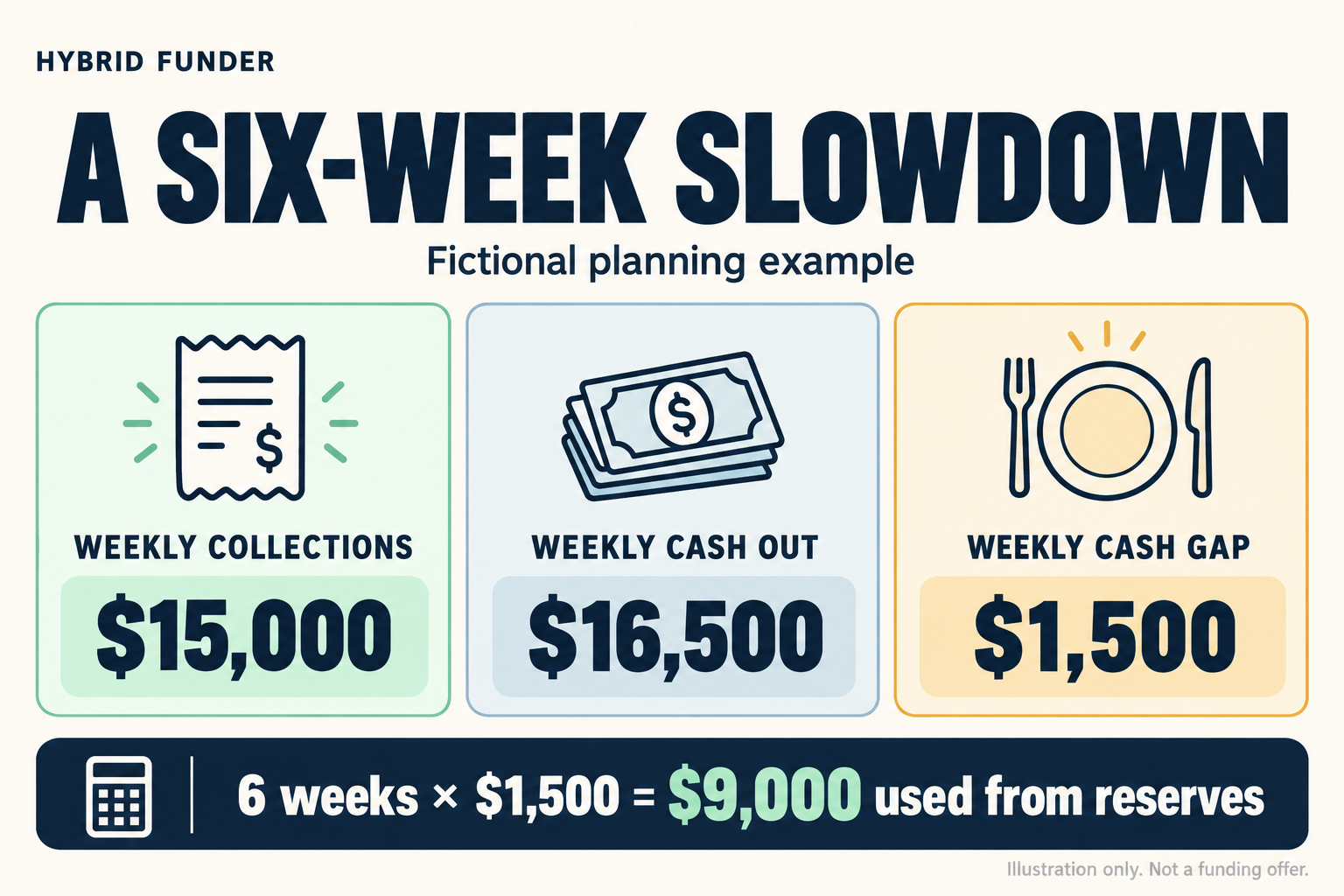
A fictional restaurant’s six-week cash test
The following numbers are a made-up planning example, not a Hybrid Funder customer, funding offer or promised result.
Imagine a neighborhood restaurant collecting $20,000 a week in a stronger period. Its weekly cash outflows total $16,500, including ingredients, wages, occupancy costs, taxes set aside and existing financing payments. That leaves $3,500 before additional spending.
Now collections fall to $15,000 a week while the initial expense plan stays at $16,500. The business is using $1,500 of reserves each week. Over six weeks, that is $9,000. A $12,000 starting reserve becomes $3,000, assuming no other inflows or outflows.
The point is not that this restaurant needs a $9,000 advance. The point is that its current plan does not balance. A larger deposit from a funding provider changes the bank balance today; it does not remove that weekly operating gap.
Write down what could realistically change: a smaller purchasing order, a revised staffing plan, a confirmed catering booking, an agreed supplier schedule or a documented reduction in overhead. Give every change an effective date. If the only answer is “sales should bounce back,” the plan needs more work.
Build the next 13 weeks before the next offer arrives
A weekly forecast can be simple. Begin each week with available cash, add expected collections, subtract cash expenses and existing financing obligations, and carry the ending balance into the following week. Mark the lowest point, not just the final balance.
Collections: realistic card settlements, cash receipts, confirmed catering payments and other expected receipts.
Operating payments: payroll, payroll taxes, rent, utilities, insurance, ingredients, delivery-platform costs and necessary maintenance.
Financing: every active daily or weekly remittance, loan payment and equipment obligation.
Reserve: a practical buffer for a repair, delayed payout or weaker service.
Do not spend money set aside for tax obligations as if it were a free operating reserve. Ask your accountant to help identify restricted or committed amounts. Track actual results beside the forecast each week so a missed assumption becomes visible quickly.
Make operational changes that have a measurable cash effect
Start with the decisions you control. Review purchasing against recent covers and spoilage rather than last season’s order. Identify menu items that contribute useful cash after their ingredient and packaging costs. A popular item can still tie up inventory or absorb too much preparation time.
Match staffing to realistic demand while respecting wage rules, service quality and your team. Closing a weak service period may save less than expected if it also loses profitable orders. Test the numbers before changing hours.
Talk to suppliers before a payment becomes overdue. Ask whether a different delivery cadence or a written payment arrangement is possible; do not assume you can change terms unilaterally. Consider catering or private-event work only at prices that cover the extra labor, food, packaging and delivery required. A discount that fills tables but loses cash makes a slow season harder.
Choose one or two specific actions, estimate their cash effect conservatively, and check the result. Avoid launching an expensive promotion on the assumption that every new customer will return.
Use the Cash-Flow Tool, then return to the weekly calendar
Hybrid Funder’s Cash-Flow Prediction Tool lets you compare existing obligations, a possible new advance and a revenue-downside scenario. Enter your own operating expenses and financing payments. Leave assumed extra sales at zero unless you have a defensible reason to include them.
The tool is an educational scenario estimator. It does not predict restaurant demand, approve funding or automatically model your seasonal weeks. A monthly chart can miss a payroll-day shortfall, so use it alongside your dated weekly forecast. Keep one-time uses of funds separate from recurring expenses to avoid counting the same cost twice.
What a factor rate does—and what it does not tell you
Consider a separate, purely illustrative example: a $20,000 advance at a 1.35 factor produces $27,000 in stated purchased receivables or payback before additional fees. That is $7,000 above the advance amount. If $500 is deducted upfront, net proceeds would be $19,500, assuming no other deductions.
If that example were divided into 40 equal weekly remittances, each would be $675. This is arithmetic, not an available offer or a description of every MCA agreement. Actual remittances, reconciliation provisions, estimated duration and other terms depend on the written contract.
A 1.35 factor is not a 35% annual interest rate, and the calculator does not convert it into APR. Use the factor-cost calculator on our homepage to examine the stated cost, then confirm the actual figures and required disclosures with the provider.
Most importantly, add the proposed payment to the slow-week forecast. In the fictional restaurant above, another $675 a week would increase its recurring cash shortfall from $1,500 to $2,175 unless other changes improve cash flow. Upfront funding provides liquidity, but the added obligation must still be supported.
When funding deserves a conversation—and when to pause
A defined, temporary timing gap is different from an ongoing operating loss. An equipment repair with a documented service impact is different from funding a promotion whose return is unknown. Neither distinction guarantees that funding is appropriate, but both make the decision more concrete.
Before accepting an offer, ask about net proceeds, the full amount owed or receivables purchased, fees, payment frequency, how remittances are determined, any reconciliation process, early-payment provisions, security interests, guarantees and restrictions involving existing funding. Get the answers in the agreement rather than relying on a verbal summary.
If your slower-sales forecast cannot support the proposed obligation, pause. Review operating changes and other options with your accountant or financial adviser. Do not assume a later renewal or another advance will be available to cover today’s payment.
Turn your winter plan into a funding conversation
You do not need a vague wish for “more money.” You need a clear next move: the repair that restores service, inventory for a confirmed order, or a temporary timing gap with a realistic recovery date. If you can name the use, show the numbers and support a new payment, the next step is to put your business in front of funding providers.
Start my restaurant funding application — share your business details and have your recent statements ready. Hybrid Funder will help organize the review; available options depend on your business and the provider.
Bring the reason for the request, the amount your forecast supports and the dates that matter. Hybrid Funder’s starting criteria are at least three months in business and $10,000 in monthly business revenue. These are initial screening thresholds, not approval standards for every provider.
Have your four most recent completed monthly business bank statements ready, including all pages. If you have only three completed months, contact the team before submitting. Be ready to explain the seasonal decline and list current obligations accurately.
Hybrid Funder, operated by Tinaz Enterprises LLC and founded by John Tinaz, connects businesses with third-party commercial funding providers. We can help organize a submission and discuss available offers. We do not directly issue the funding, and a provider determines eligibility, approval, costs, terms and timing.
Plan the quieter weeks before they become urgent. Start with the cash-flow scenario tool, read our restaurant funding guide, or talk with the Hybrid Funder team about your business. If you are ready with accurate details and documents, start a business funding application.
Educational planning content, not individualized financial, legal or tax advice. Examples are fictional and do not establish eligibility or an offer. Available products and terms vary by provider and location. Hybrid Funder may receive compensation for arranging funding. Review the provider’s agreement and applicable disclosures before deciding.